
Farm & Ranch Fencing
Field fence, barbed wire, corral panels, gates. Built for real working land.
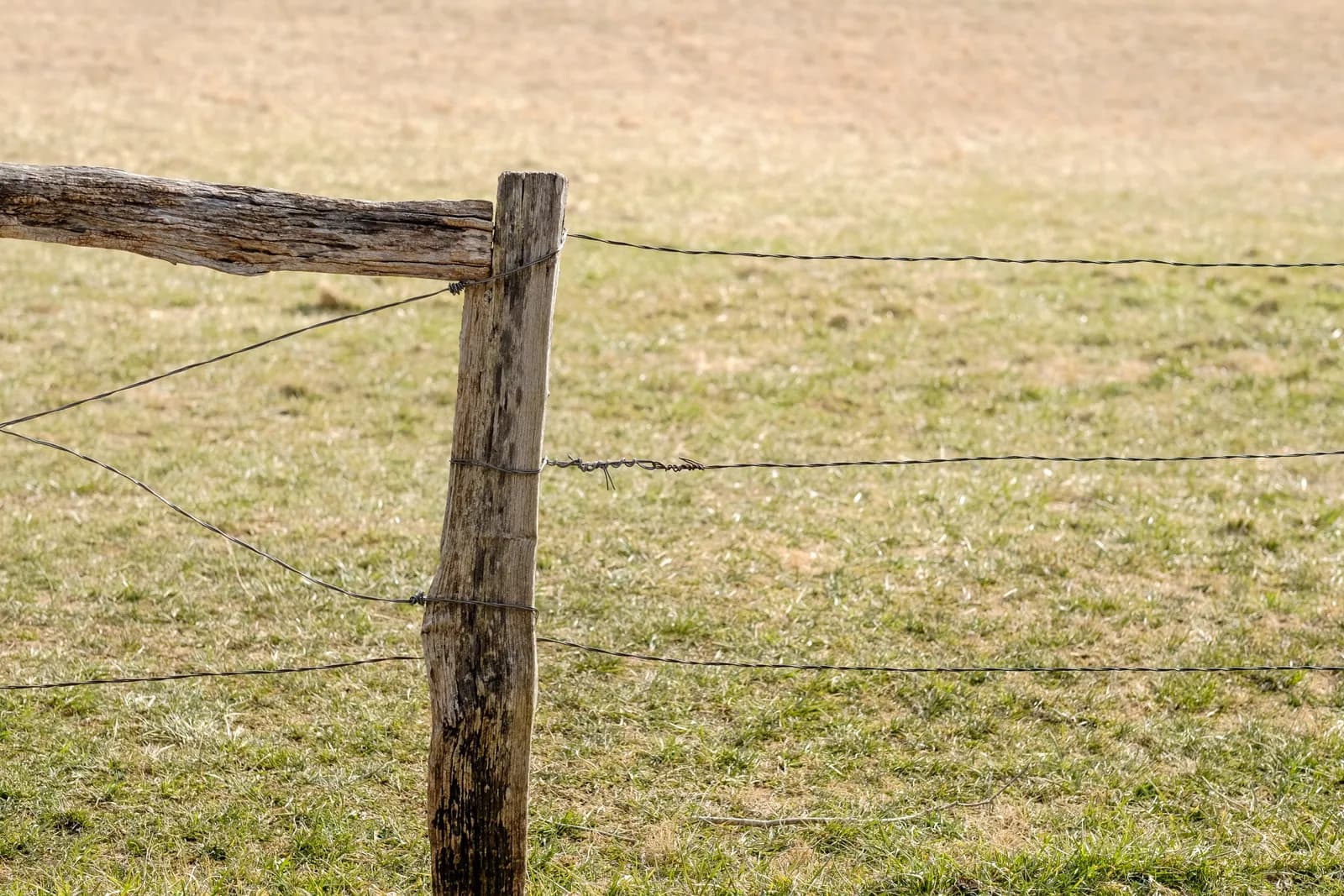
Farm fence is a different animal than yard fence, and not just because of what it holds. A residential fence is a few hundred feet on flat, accessible, surveyed ground. A fence line on acreage runs through drainages, over rock, across ground that hasn't been level since it was uplifted, and it has to hold tension across all of it while livestock lean on it.
It also has to be worth building. Nobody puts a $60-a-foot fence around forty acres. Farm and ranch work is an economics problem as much as a construction one: what's the cheapest fence that will actually do the job for twenty years, and where do you spend the money that matters.
The corner is the fence
Everything on a wire fence is tension, and every bit of that tension terminates at a corner or an end. If the corner assembly moves, the fence goes slack. If the fence goes slack, livestock find out before you do.
That's why the H-brace exists: two posts, a horizontal brace between them, and a diagonal brace wire tensioned to keep the pull post from tipping toward the fence line. It's an old design because it works. On long runs, heavy tension, or soft ground, we go to a double H. On corners we brace in both directions, because a corner is pulling two ways.
This is the part of a farm fence where cutting cost is a false economy. Line posts are cheap and replaceable. A corner that fails takes the whole run with it. We spend money at the corners, the ends, and the gates, and we're honest about spending less between them.
- ▸H-brace at ends; double H on long runs and soft ground
- ▸Corners braced in both directions
- ▸Brace wire tensioned — a loose brace wire is a decoration
- ▸Corner and gate posts set deepest, in concrete where the ground calls for it
Picking the wire for the animal
The fence follows the livestock. That's the whole selection logic, and anyone selling you one fence for every animal is selling you a fence.
Woven / field wire — the vertical-and-horizontal grid — is what you want where you need a physical barrier that can't be pushed through or stepped over. Smaller stock (goats, sheep) and anything you actually need to contain rather than merely discourage. Graduated spacing, tighter at the bottom, is the standard for a reason.
Barbed wire is the classic cattle perimeter: cheap per foot, fast to run over long distances, and it works on animals that respect a boundary. It's a poor choice around horses — a horse that panics into barbed wire gets cut badly, and every horse owner we've worked with already knows it.
High-tensile smooth wire holds tension over long spans with fewer posts, which is exactly what you want on big acreage. It can be electrified, which turns a physical fence into a psychological one and dramatically extends what it can hold. Corral and working pens are their own category: welded pipe or panel, because that's where animals get crowded and pressure gets real.
- ▸Woven / field wire — goats, sheep, anything that has to be contained
- ▸Barbed wire — cattle perimeter; not for horses
- ▸High-tensile — long spans, fewer posts, electrifiable
- ▸Pipe / corral panel — working pens where pressure is highest
Colorado ground and Colorado weather
Land east and south of the metro is largely open plain, and that means wind with nothing to break it. Wire fence handles wind well — it's mostly air — but it's tumbleweed that gets you. Weeds pack against a wire fence in a blow until the fence stops being a wire fence and becomes a wall, and a wall on the plains catches wind and snow until posts start going over. Keeping a fence line clear is real maintenance out there.
Snow does the same thing. Drifts pack against a fence line, load the wire, and pull on the posts and the corners for weeks. This is one more argument for corner assemblies that are overbuilt rather than adequate.
Ground varies enormously. Front Range clay is workable and holds a post but swells and shrinks with moisture, working posts loose over years. Ground toward the foothills and south into Douglas County gets rocky and gravelly, and rock changes everything about a post job — sometimes for the better, since a post set in rock isn't going anywhere, and sometimes for the worse when we're drilling instead of augering. We walk the line before we quote acreage, because the ground is the cost.
Gates, and where fence lines actually fail
Gates are where farm fence fails, every time. A gate is a moving part in a system that has no other moving parts, it takes the tension load of the fence at its post, and it gets used daily by people in a hurry, often from a truck.
So we size gates to the equipment, not to the animal. If a hay truck or a tractor with an implement needs to get through, the opening has to take it — the fence you have to cut a hole in later is a fence built to the wrong spec. We hang gates on posts set for the load, we brace them, and we hang them so they swing true and latch without lifting.
The other failure point is where a fence crosses a drainage. Water moves under a fence line, undercuts posts, and carries debris that piles up against wire. Those crossings need thought — a floodgate or a wire gap that gives instead of ripping the fence out in a big flow.
What we quote, and how
Farm and ranch fencing is quoted per job, not per foot off a chart, because the spread is enormous. Barbed wire across flat, accessible pasture and woven wire through a rocky drainage with three gates and a corral are not the same product and shouldn't be priced like they are.
What moves the number: total footage, wire type, terrain and rock, how many corners and ends (each one is a braced assembly), how many gates and how wide, whether we're clearing an old fence line, and whether a truck can get to the work or we're packing material in. We walk it, we count the corners, and we give you a number that accounts for what's actually out there.
What it costs
Farm and ranch work is quoted per job — the range across wire type, terrain, and corner count is too wide for a per-foot number to mean anything honest. Barbed wire across flat, open pasture is one of the cheapest fences per foot there is; woven wire through rocky ground with multiple braced corners and equipment gates is many times that. We walk the line and count the corners before we put a number on it.
That is not a quote.Those are typical Front Range market ranges, given so you can sanity-check what you're being told. The only number that means anything is the one we write after we walk your lot. Get a free estimate.
Questions we get
What kind of fence do I need for horses?
Not barbed wire. A horse that panics into barbed wire gets cut badly. Woven wire with a top rail, smooth high-tensile (often electrified), or pipe and rail are the standard safe choices. What's right depends on the acreage, the number of horses, and the budget — we'll talk it through on-site.
Why does the corner post cost so much more than the line posts?
Because the corner is the fence. All the tension in a wire run terminates at the corners and ends, and a corner is a braced assembly — an H-brace or double H — not a single post. Line posts are cheap and replaceable. A corner that fails takes the entire run with it.
How do you price farm fence?
Per job, after we walk the line. Total footage, wire type, terrain and rock, the number of braced corners and ends, gate count and width, whether an old fence needs clearing, and whether a truck can reach the work all move the number more than the wire itself does.
Can you build a fence on rocky ground?
Yes. Rock changes the method — sometimes we're drilling and setting rather than augering, and that's slower and costs more. It also has an upside: a post properly set in rock is not going anywhere. We walk the line before quoting acreage precisely because the ground is the cost.
Do you do corrals and working pens?
Yes. Corrals and pens are a different build than fence line — welded pipe or panel, because that's where livestock get crowded and pressure gets real. Wire that's fine on a perimeter is the wrong material in a working pen.
Farm & Ranch fence, close to home
Ground, wind, and fence rules change from city to city on the Front Range. Here's what farm & ranch work looks like where you live.